

Road Vehicle Regulatory Approach
The Department of Infrastructure, Transport, Regional Development, Communications, Sport and the Arts released its Road Vehicle Regulatory Approach, outlining how it regulates compliance under the Road Vehicle Standards Act 2018 (RVSA), the Road Vehicle Standards Rules 2019, and the New Vehicle Efficiency Standard Act 2024 (NVES).
The document explains how the Department works with industry to support compliance while taking a risk-based approach to monitoring and enforcement. Its objective is to encourage voluntary compliance, provide assistance where appropriate, and apply proportionate enforcement action where non-compliance is identified.
A Risk-Based Regulatory Approach
The Department’s regulatory approach focuses compliance activities on areas and entities that present the greatest risk, while minimising unnecessary regulatory burden for businesses demonstrating strong compliance. Regulatory responses are proportionate to the level of risk and the nature of any non-compliance.
This approach utilises the following elements:
- Risk identification: actively identifying and documenting historical, current and emerging risks in our regulatory environment.
- Risk assessment: assessing the likelihood and consequence of identified risks, considering the effectiveness of any controls.
- Risk prioritisation: prioritising the risks, together with the risk assessment, informing the design of compliance activities, allocation of resources to compliance activities and selection of the most appropriate compliance or enforcement response.
- Control assessment: identifying and assessing the effectiveness of controls currently used to modify or prevent the likelihood or consequence of the risk.
- Allocation of resources to compliance activities: allocating resources to compliance activities in proportion to the risk and guided by the risk priority.
- Tailoring of the enforcement response: tailoring enforcement or compliance responses based on the severity and behavioural drivers of the non-compliance.
The Compliance Model
The Department’s compliance model is built around four escalating levels of compliance:
- Voluntary compliance – supporting industry through guidance, education and accessible information.
- Assisted compliance – providing targeted assistance where non-compliance results from error or misunderstanding, including inspections and monitoring where required.
- Directed compliance – undertaking targeted compliance activities and applying regulatory actions such as approval variations, suspensions, infringement notices or enforceable undertakings where appropriate.
- Enforced compliance – applying stronger enforcement measures, including civil penalties or prosecution, where deliberate or repeated serious non-compliance occurs.
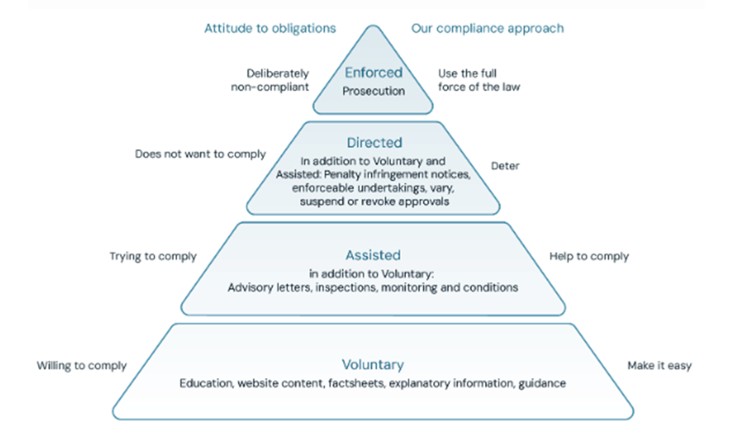

The model recognises that while most regulated entities seek to comply with the legislation, regulatory responses will escalate where risks or non-compliant behaviour increase.
Enforcement Mechanics
Where non-compliance escalates beyond assisted compliance, the Department can draw on a broader set of powers under the RVSA and the Regulatory Powers (Standard Provisions) Act 2014. These allow the Department’s response to scale with the seriousness of the non-compliance.
This includes:
- Inspections and monitoring – where authorised officers may enter premises, examine activities, inspect documents and take samples to confirm compliance.
- Investigations – where the Department gathers evidence and may refer serious matters to the Commonwealth Director of Public Prosecutions.
- Infringement notices, a penalty offered as an alternative to court action for less serious breaches.
- Civil penalties, court-ordered fines sought by the Department for confirmed breaches.
- Enforceable undertakings, written commitments from an entity to correct or prevent non-compliance.
- Injunctions, court orders that stop a non-compliant activity or compel an entity to act.
In the most serious cases of deliberate or repeated non-compliance, the Department may pursue prosecution, which can carry significant financial penalties.
For more information, including how the Department supports and enables regulated entities to comply with their obligations under the RVSA, visit the Department’s Road Vehicle Regulatory Approach publication.
For further questions or assistance, head to the Department’s RVSA-dedicated Contact Us page.